Walking on a highway — whether out of necessity following a vehicle breakdown, as a shortcut between destinations, or simply because no other route is available — is something that thousands of Americans do every year, often without fully understanding the legal framework that governs pedestrian access to highway corridors. The question of whether walking on a highway is illegal involves federal and state highway design standards, pedestrian traffic laws, the specific classification of different types of roadways, and the very real public safety concerns that motivate restrictions on pedestrian highway access. The legal answer is nuanced — walking on highways is prohibited or restricted in many circumstances, legal in others, and highly dependent on the type of roadway involved.
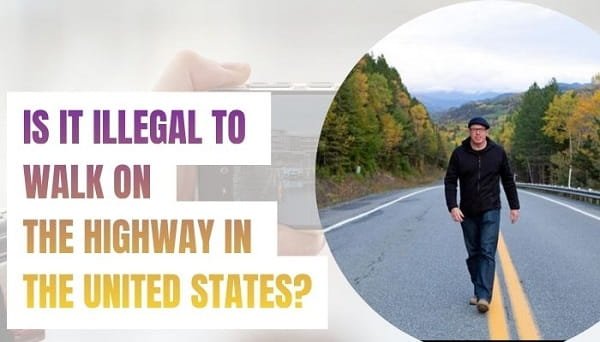
The Critical Distinction: Controlled-Access vs. Non-Controlled-Access Highways
The most important legal distinction in understanding pedestrian highway access is the difference between controlled-access highways — such as interstate freeways and expressways — and non-controlled-access highways — such as rural state highways and US routes that pass through towns and communities. These two categories of highways are governed by fundamentally different legal frameworks regarding pedestrian access.
Controlled-access highways — the interstate freeway system and equivalent limited-access expressways — are specifically designed to prohibit all pedestrian access. The Federal Highway Administration’s design standards for the National Highway System require that controlled-access facilities maintain separation between motor vehicle traffic and all other modes of transportation including pedestrians, bicyclists, and equestrians. State laws implementing these federal design standards uniformly prohibit pedestrians from walking on or along the travel lanes of controlled-access highways.
Walking on an interstate highway — whether on the travel lanes, the paved shoulder, or the maintained right-of-way — is explicitly prohibited by the traffic codes of virtually every U.S. state. These prohibitions reflect both the safety reality of mixing pedestrians with 70-mph highway traffic and the federal design standards that require controlled-access highway systems to be separated from all other transportation modes. Violations of pedestrian access prohibitions on controlled-access highways are typically civil traffic infractions carrying fines, and in cases where pedestrian presence on a freeway creates an emergency situation, more serious charges including reckless endangerment may apply.
Exceptions for Emergency Situations
Every state recognizes that emergency situations can place pedestrians on highways in circumstances where the general prohibition cannot be enforced against them — a driver whose car breaks down and who must walk on the highway shoulder to reach an emergency phone or to flag down help, a person who is involved in a breakdown and must move briefly onto a highway surface to address a safety issue, or other genuine emergency circumstances. These emergency exceptions are recognized in the law through defenses and prosecutorial discretion rather than through formal statutory exemptions, and they are narrowly construed to cover genuine emergencies rather than general permission to walk on controlled-access highways under any circumstances.
Non-Controlled-Access Highways: A Different Legal Framework
The situation for non-controlled-access highways — rural routes, state highways, and US numbered routes that run through communities — is legally more nuanced. Many of these roadways pass through areas without sidewalks or designated pedestrian facilities, and the legal framework governing pedestrian use reflects this reality.
Most state traffic codes permit pedestrians to walk along non-controlled-access highways in the absence of sidewalks, provided they follow specific rules designed to maximize their visibility and minimize conflict with vehicle traffic. The most universal rule governing pedestrians on roadways without sidewalks is the walk-facing-traffic requirement — pedestrians must walk on the left side of the roadway facing oncoming traffic rather than walking with their backs to approaching vehicles. This requirement gives the pedestrian maximum visibility of approaching vehicles and allows them to take evasive action if a vehicle fails to give adequate clearance.
Pedestrians walking on highway shoulders in rural areas — along state routes through rural counties, on US highways through agricultural areas, or on other non-controlled-access roads without sidewalk infrastructure — are generally exercising a legally recognized right to use the highway as a pedestrian in the absence of better facilities, provided they comply with applicable pedestrian traffic rules and exercise due care for their own safety.
State-Specific Pedestrian Highway Laws
State traffic codes vary in how specifically they address pedestrian access to different classes of highways. Texas Transportation Code provisions address pedestrian conduct on highways and specifically regulate walking along roadways both with and without sidewalks. Florida’s pedestrian traffic law includes detailed provisions about where pedestrians may walk along roadways, incorporating both the prohibition on controlled-access highway walking and the specific rules for walking on the roadway in the absence of sidewalks. California Vehicle Code addresses pedestrian access in ways that reflect the state’s extensive controlled-access freeway network and the complex pedestrian access issues that arise in its diverse geographic and urban-rural landscape.
Safety Realities and Enforcement
The legal restrictions on highway walking are grounded in compelling safety data. Pedestrian fatalities on highways — particularly on controlled-access freeways where pedestrians have no legal right to be — account for a significant portion of traffic fatalities each year. The combination of high vehicle speeds, driver expectation that no pedestrians will be present, limited pedestrian visibility at night, and the physics of vehicle-pedestrian collisions makes freeway walking extraordinarily dangerous regardless of its legal status.
Law enforcement response to pedestrians on controlled-access highways ranges from citation for the traffic infraction to emergency removal for the pedestrian’s safety — officers who find a pedestrian on an active freeway typically prioritize getting the person to safety before processing any potential violation, reflecting both the humanitarian concern for the pedestrian’s safety and the practical reality that the pedestrian’s presence on the roadway creates a danger for other motorists as well.
The Bottom Line on Walking on the Highway
Walking on controlled-access highways including interstate freeways and limited-access expressways is explicitly prohibited by state traffic law in all U.S. states and reflects federal highway design standards that require pedestrian exclusion from these facilities. Walking on non-controlled-access rural highways and state routes without sidewalks is generally permitted under most state traffic codes provided pedestrians follow applicable rules including walking facing traffic and exercising reasonable care. Emergency situations provide limited practical exception to controlled-access highway prohibitions. The safety rationale for these legal restrictions is compelling and reflects the genuine and serious danger of mixing pedestrian and high-speed vehicle traffic in a shared space.