Skydiving is one of the most exhilarating and highly regulated aviation activities in the United States, governed by a comprehensive framework of federal aviation regulations that address every aspect of parachuting operations from equipment standards to aircraft requirements to the specific meteorological conditions under which jumps can be legally conducted. The question of whether skydiving through a cloud is illegal is one that most people outside the aviation and skydiving community would never think to ask — it sounds like the kind of arcane regulatory question that only professional skydivers and aviation attorneys would need to know about. But the answer involves a genuine and actively enforced federal regulatory provision with real safety rationale and meaningful legal consequences for violations.
Federal Aviation Regulations and Parachuting Operations
The legal framework governing skydiving in the United States is primarily established by the Federal Aviation Administration through Federal Aviation Regulations codified in Title 14 of the Code of Federal Regulations. The FAA’s regulatory authority over aviation activities is comprehensive and extends to parachuting operations, which are addressed specifically in 14 C.F.R. Part 105 — the federal regulation governing parachute operations.
Part 105 establishes the conditions under which parachute operations may legally be conducted, including requirements related to aircraft equipment, parachute certification, pilot responsibilities, and critically for our purposes, the meteorological conditions under which jumps are permitted. These weather-related provisions are where the cloud prohibition is found.
The Specific Cloud Proximity Rules for Skydiving
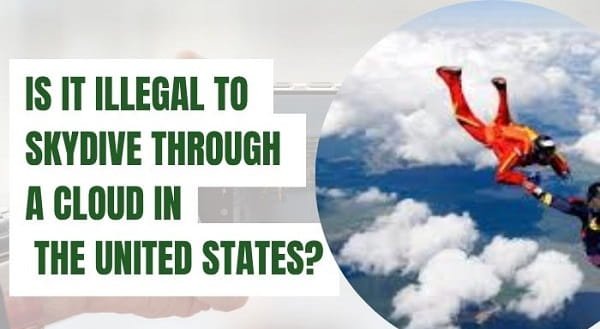
Under 14 C.F.R. Part 105, parachute operations are prohibited in or through clouds. Additionally, parachutists must maintain specific minimum distances from clouds even when they are not jumping directly through them. The regulation requires that parachute operations be conducted clear of clouds and at distances that provide adequate visibility and separation from cloud formations that could conceal other aircraft, impair the parachutist’s situational awareness, or create navigation difficulties that compromise the safety of the operation.
The specific visual meteorological conditions requirements under Part 105 interact with the broader airspace classification rules of 14 C.F.R. Part 91, which establish the minimum visibility and cloud distance requirements for visual flight rules operations in different classes of airspace. For most parachute drop zones operating in Class G airspace below 1,200 feet above ground level, the visibility requirements and cloud clearance requirements are determined by the applicable airspace classification at the altitude of the jump, not just at ground level.
For parachute operations conducted in controlled airspace — Class E airspace above 700 feet and Class D, C, and B airspace — more stringent visibility and cloud clearance requirements apply. These requirements include maintaining specified horizontal distances from clouds — commonly 2,000 feet horizontally — and specified vertical distances from cloud bases and tops, in addition to minimum flight visibility requirements.
Why Cloud Penetration Is Prohibited
The safety rationale behind the prohibition on skydiving through clouds is straightforward and compelling. When a skydiver is inside a cloud, they have zero visibility of other aircraft that may be operating in the same airspace. Instrument-rated pilots flying in instrument meteorological conditions — inside clouds — operate under IFR flight plans and are separated from other IFR traffic by air traffic control, but they are not separated from uncontrolled parachutists who have entered the cloud without any communication with ATC or any means of detecting and avoiding instrument traffic.
A collision between a skydiver and an aircraft in instrument meteorological conditions would be catastrophic and almost certainly fatal for all involved. The prohibition on cloud penetration by parachutists is one of the fundamental safety provisions that prevents this scenario from occurring by requiring that parachuting operations be conducted only in conditions where the parachutist can see and be seen by other airspace users.
The prohibition also addresses the parachutist’s own safety. A skydiver inside a cloud has no visual reference to the ground, no ability to assess their position relative to terrain or obstacles, no ability to navigate toward their intended landing zone, and no way to identify and avoid hazards that would be visible in clear air. Disorientation in clouds has caused serious accidents in aviation broadly, and the risks are equally acute for parachutists.
Enforcement and Penalties
The FAA actively enforces Part 105 requirements through its Inspector General’s office, the FAA’s Flight Standards District Offices, and through incident reporting systems that allow violations to be identified and investigated. Violations of parachute operation regulations including prohibited cloud operations can result in civil monetary penalties against the parachutist, the pilot in command of the jump aircraft, and the drop zone operator. Civil penalties under the FAA’s enforcement framework can reach tens of thousands of dollars for serious violations.
The FAA can also take certificate action against licensed pilots who conduct parachute drops in violation of Part 105 requirements, potentially suspending or revoking the pilot’s certificate depending on the severity of the violation and the pilot’s history. Drop zones that operate in violation of federal parachuting regulations face potential operational suspensions and the possibility of losing their waiver authority to operate in the applicable airspace.
USPA Guidelines and Self-Regulation
The United States Parachute Association — the primary national organization representing skydivers and parachuting operations in the United States — has its own Group Member guidelines that are applied at USPA-affiliated drop zones and that reinforce and in some cases exceed the FAA’s minimum regulatory requirements for cloud clearance. USPA-affiliated drop zones are required to conduct operations in compliance with both FAA regulations and USPA guidelines as a condition of their group membership, creating a self-regulatory layer that supplements federal enforcement.
Most legitimate drop zones in the United States are USPA Group Members and actively comply with both FAA regulations and USPA guidelines as a matter of standard operating procedure. Cloud prohibitions are taken seriously in the professional skydiving community not only because they are legally required but because the safety rationale behind them is immediately apparent to anyone who understands the airspace environment in which parachutists operate.
The Bottom Line on Skydiving Through Clouds
Skydiving through a cloud is explicitly prohibited by federal aviation regulations under 14 C.F.R. Part 105, which requires that parachute operations be conducted in visual meteorological conditions with specified minimum distances from cloud formations. The prohibition reflects compelling safety rationale — parachutists inside clouds cannot see or be seen by aircraft operating in instrument conditions, creating collision risk that is potentially fatal for everyone involved. FAA enforcement of these requirements can result in substantial civil penalties and certificate action against pilots and drop zone operators. The professional skydiving community through USPA guidelines actively reinforces these federal requirements as a standard safety practice at affiliated drop zones across the country.