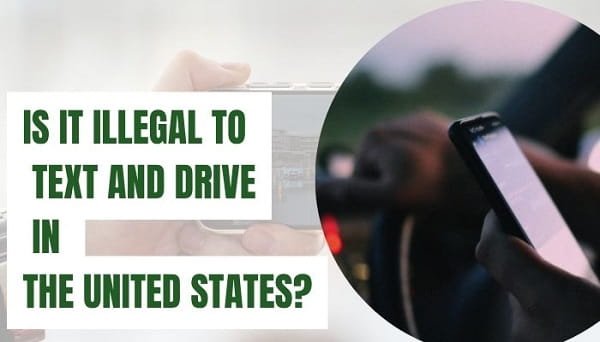
Few driving behaviors have generated as much legislative attention, public safety advocacy, and law enforcement focus over the past two decades as texting while driving. The combination of a smartphone in nearly every American’s pocket and the compulsive desire to remain connected has created one of the most dangerous driving behaviors documented by traffic safety researchers — and one that has been addressed through an increasingly comprehensive body of state and local law across the country. The legal answer to whether texting while driving is illegal is yes in virtually every U.S. state, but the specific legal framework, penalties, and enforcement approaches vary enough across jurisdictions to warrant careful examination by every driver.
The National Landscape: State-by-State Prohibition
Texting while driving is explicitly prohibited by statute in 48 U.S. states and the District of Columbia. Montana and Missouri are the only states that do not have statewide bans on texting while driving for all drivers, though Missouri prohibits texting while driving for drivers under 21 years of age. This near-universal prohibition reflects a broad legislative consensus that has developed over the past fifteen years as traffic safety data consistently demonstrated that manual texting while operating a motor vehicle creates accident risk comparable to or exceeding drunk driving in terms of reaction time impairment and crash likelihood.
The legislative wave that produced these state texting bans began in earnest in the late 2000s and accelerated through the 2010s as smartphone adoption became universal and distracted driving fatality statistics became impossible to ignore. The National Highway Traffic Safety Administration reported thousands of annual fatalities attributable to distracted driving, with manual cell phone use and texting representing the most commonly documented forms of attention-diverting behavior.
Federal Law and the Role of the Federal Government
There is no federal statute that specifically prohibits texting while driving for private passenger vehicle operators. However, the federal government has played a significant role in promoting state-level prohibition through the Distracted Driving Prevention program administered by the National Highway Traffic Safety Administration, which provides grant funding to states that enact and enforce distracted driving laws. Federal regulations do specifically prohibit texting while driving for commercial motor vehicle operators — truck drivers and bus drivers — under Federal Motor Carrier Safety Administration regulations, making texting while operating a commercial vehicle a federal violation in addition to any applicable state law.
Primary vs. Secondary Enforcement
An important legal distinction in how state texting bans are enforced involves whether the prohibition is subject to primary or secondary enforcement. A primary enforcement law allows a law enforcement officer to stop a vehicle and issue a citation solely because the officer observed the driver texting — no other traffic violation needs to have occurred. A secondary enforcement law, by contrast, only allows an officer to cite a driver for texting if the vehicle has already been stopped for a separate primary traffic violation.
Most states that prohibit texting while driving have enacted primary enforcement provisions, recognizing that secondary enforcement significantly limits the practical deterrent effect of the ban. States with primary enforcement demonstrate significantly higher citation rates and research suggests greater behavioral change among drivers compared to states that limit enforcement to secondary situations. Drivers in states with secondary enforcement may be technically violating the texting ban without realistic fear of being stopped solely for that reason, which undermines the public safety objective the law is designed to achieve.
Handheld Device Laws Beyond Texting
Many states have moved beyond specific texting prohibitions to enact broader handheld device bans that prohibit any manual use of a mobile phone or portable electronic device while operating a motor vehicle. These broader prohibitions — enacted in states including California, New York, Washington, Oregon, Georgia, and many others — make it illegal to hold a phone in hand for any purpose while driving, including for phone calls, navigation, music control, and any other application use, not just texting.
California’s handheld device law prohibits drivers from holding and using a mobile phone for any purpose while operating a vehicle, requiring all phone use to be conducted through Bluetooth, speakerphone in a mounted position, or other hands-free technology. New York’s law similarly prohibits the use of handheld electronic devices while driving, and enforcement through high-visibility campaigns has resulted in hundreds of thousands of citations annually.
Penalties for Texting While Driving
The penalties for texting while driving vary considerably across states but have generally increased over time as legislators have responded to public safety concerns with stronger deterrents. First offense fines range from $20 in some states to $200 or more in states with stricter penalty structures. Many states impose enhanced fines for subsequent violations, with second and third offenses carrying fines of several hundred dollars. Several states also impose demerit points on drivers’ records for texting violations, with accumulated points potentially triggering license suspension.
States that have experienced high-profile fatal accidents involving texting drivers have sometimes enacted particularly aggressive penalty structures. Alaska’s texting while driving penalties include fines of up to $10,000 and potential jail time — among the most severe in the country. States that have recently strengthened their distracted driving laws have moved toward treating serious accidents caused by texting as reckless driving or even vehicular manslaughter, with criminal penalties including imprisonment in cases where texting contributed to fatal accidents.
Civil Liability and Insurance Consequences
Beyond criminal penalties, texting while driving creates substantial civil liability exposure in the event of an accident. An at-fault driver who was texting at the time of a crash faces a powerful negligence case — violating a specific traffic safety statute is typically treated as negligence per se in civil proceedings, meaning that the violation of the texting ban establishes the negligence element of a personal injury claim without requiring additional proof of unreasonable conduct. Distracted driving accident cases involving documented texting frequently result in larger damages awards than comparable accidents without documented distraction.
Insurance consequences of texting violations are similarly significant. A texting-while-driving citation typically results in meaningful premium increases at renewal, and an accident caused by texting can result in substantially elevated rates or policy non-renewal depending on the insurer and the severity of the incident.
The Bottom Line on Texting and Driving
Texting while driving is explicitly illegal in 48 states and is prohibited for commercial drivers nationwide under federal regulation. Broader handheld device bans in many states extend these prohibitions to all manual phone use while driving. Primary enforcement laws allow officers to stop and cite texting drivers without requiring a separate violation. Penalties range from modest fines to serious criminal charges in accident cases. Civil liability and insurance consequences add significant financial exposure beyond the immediate citation. The legal framework reflects an overwhelming national consensus that manual phone use while driving creates unacceptable public safety risks that the law must address forcefully.