Speed limit law is among the most universally understood areas of American traffic regulation — virtually every driver knows that exceeding the posted speed limit is a traffic violation subject to fines, points, and potential license consequences. But the reverse question — whether driving significantly below the posted speed limit can also be illegal — is one that catches many drivers off guard. Most people assume that driving slowly is inherently cautious and therefore legal, but the legal framework governing minimum speeds and impeding traffic flow reveals a more nuanced picture that every driver should understand.
Maximum Speed Limits vs. Minimum Speed Limits
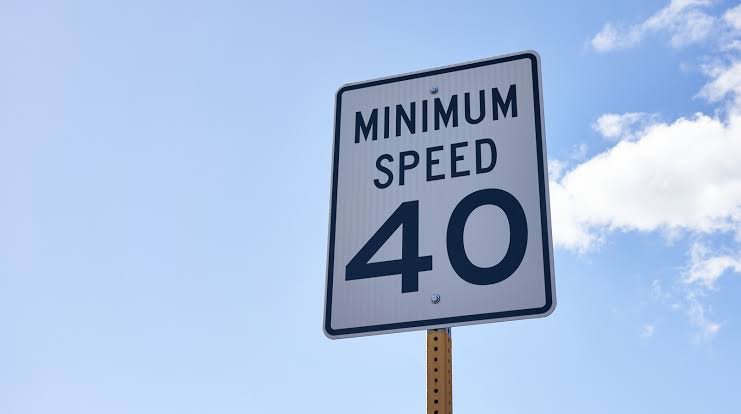
The starting point for understanding the legality of driving under the speed limit is the distinction between maximum speed limits and minimum speed limits. Maximum speed limits establish the fastest speed at which a vehicle may legally travel on a given road. Minimum speed limits — which exist on specific types of roads in most states — establish the slowest speed at which a vehicle may legally travel under normal conditions. Driving below a posted minimum speed limit is as clearly a traffic violation as driving above a posted maximum speed limit.
Minimum speed limits are most commonly posted on interstate highways and limited-access expressways where traffic flows at high speeds and where very slow vehicles create significant safety hazards through the speed differential they create relative to surrounding traffic. These roadways are engineered for sustained high-speed travel, and vehicles traveling at 25 or 30 miles per hour when surrounding traffic is moving at 65 or 70 miles per hour create a dangerous speed differential that dramatically increases the risk of rear-end collisions.
Most states post minimum speed limits on portions of their interstate highway systems in the 40 to 45 miles per hour range, and some interstate segments have minimum speed limits as high as 50 miles per hour. Drivers who travel below these posted minimums — absent a specific safety exception — are violating the minimum speed law just as they would violate a maximum speed limit by exceeding it.
Impeding Traffic Flow: The Broader Legal Prohibition
Beyond posted minimum speed limits, virtually every U.S. state has a separate and broader provision that prohibits driving so slowly as to impede or block the normal flow of traffic. These impeding traffic provisions are distinct from minimum speed limit violations and apply even on roads without posted minimum speed limits. The typical statutory language prohibits operating a vehicle at such a slow speed as to impede or block the normal and reasonable movement of traffic, except when reduced speed is necessary for safe operation or is in compliance with law.
This impeding traffic provision captures slow driving that creates hazardous conditions even when the specific road has no posted minimum speed. A driver traveling 20 miles per hour on a two-lane highway with a 55 mile per hour maximum speed limit may not be violating a posted minimum speed requirement, but if their speed is causing a dangerous backup of vehicles behind them or creating unsafe passing conditions, they may be cited for impeding traffic flow under their state’s general slow driving prohibition.
The Safety Rationale for Minimum Speed Requirements
The legal restrictions on excessively slow driving reflect genuine and well-documented safety concerns. Traffic safety research has consistently shown that the greatest accident risk comes not from drivers traveling at the average speed of traffic but from those traveling significantly faster or significantly slower than the prevailing traffic flow. The speed differential between a very slow vehicle and surrounding traffic creates the same type of dangerous passing and rear-end collision scenarios as the speed differential between a very fast vehicle and normal traffic.
A vehicle traveling at 25 miles per hour on an interstate highway where traffic is moving at 70 miles per hour represents a relative speed differential of 45 miles per hour for a driver approaching from behind. The closing speed of the approaching vehicle is so high that even an attentive driver may have insufficient time and distance to safely brake or change lanes when they first see the slow vehicle ahead. At night, in poor weather, or in heavy traffic conditions, this hazard is compounded significantly.
Exceptions for Necessary Slow Driving
Every state’s minimum speed and impeding traffic provisions include exceptions for situations where reduced speed is necessitated by legitimate safety concerns. Vehicles that must slow down due to mechanical problems, vehicles navigating road hazards, vehicles slowing for traffic control devices, vehicles in construction zones where slow progress is unavoidable, and vehicles whose operators are experiencing a medical emergency are all recognized exceptions to the general prohibition on impeding traffic flow.
The key legal concept in these exceptions is necessity — the slow driving must be genuinely necessitated by a safety or mechanical situation beyond the driver’s normal control, not simply a preference for slower travel or inattentiveness to traffic conditions. A driver who is fully capable of maintaining the minimum legal speed and chooses not to — perhaps out of general caution, a preference for slow driving, or distraction — does not benefit from the safety exception.
Left Lane Laws and Slow Driving
Related to the minimum speed framework is the growing body of left lane laws that many states have enacted to address slow drivers who occupy the left passing lane of multi-lane highways without actively passing other vehicles. These laws — enacted in states including Florida, Georgia, Indiana, Kansas, Missouri, New Jersey, Tennessee, and others — specifically require drivers who are not actively passing to move out of the left lane and yield to faster-moving traffic.
Left lane laws address the specific situation where a driver’s below-flow-speed travel in the passing lane creates a bottleneck that forces other drivers to pass on the right — a dangerous maneuver — or to follow too closely in frustration. Several states have made left lane camping a primary enforcement violation subject to fines of $100 or more, and enforcement of these provisions has increased as legislative attention to highway traffic management has grown.
Specific State Approaches
California Vehicle Code Section 22400 specifically prohibits operating a vehicle at such a slow speed as to impede or block normal traffic flow and allows officers to cite slow drivers just as they would cite speeders. California also prohibits the operation of a vehicle on a highway if the vehicle cannot maintain a minimum speed of 40 miles per hour on specific limited-access highways. Texas Transportation Code provisions address minimum speed requirements on interstate highways and establish impeding traffic prohibitions applicable to all public roadways. Florida’s statute similarly addresses slow driving as a traffic violation with associated fines and potential point consequences.
Circumstances Where Very Slow Driving Is Legally Required
While driving too slowly can be illegal, there are circumstances where law requires a driver to slow dramatically below the normal speed of traffic. School zones with active crossing signals, construction zones with posted reduced speed limits, railroad crossings, emergency scenes, and road conditions including ice, fog, and heavy rain all legally require or may necessitate reduced speeds. In these contexts, slowing well below the maximum speed limit is not merely legal but mandatory, and other drivers must accommodate the reduced speeds created by these conditions.
The Bottom Line on Driving Under the Speed Limit
Driving under the speed limit can be illegal in several distinct ways — violating a posted minimum speed limit on an interstate or expressway, impeding the normal flow of traffic under a state’s general slow driving prohibition, or occupying the left passing lane without actively passing under states with dedicated left lane laws. The safety rationale for these provisions is compelling, reflecting the genuine hazard that very slow vehicles create through speed differential with surrounding traffic. Safety exceptions apply when reduced speed is genuinely necessitated by mechanical, road, or emergency conditions. The legal message is that speed limits define both a maximum and — in specific circumstances — a minimum acceptable speed, and the safest legal driving maintains a speed that is consistent with the normal flow of traffic on any given road.