The construction of a new ballroom at the White House has turned into one of the most controversial legal battles in recent U.S. history. What began as a large renovation project has now become a courtroom fight involving preservation laws, presidential authority, and even national security claims.
Background of the Project
The project was initiated by Donald Trump as part of a broader plan to redesign parts of the White House complex. The proposed ballroom is massive—around 90,000 square feet—and is estimated to cost roughly $400 million.
To make space for the new structure, the historic East Wing of the White House was demolished in 2025. This decision itself sparked criticism, as the East Wing had long-standing historical and architectural importance.
Supporters of the project argue that the new ballroom would allow the White House to host larger state events and reduce reliance on temporary tents for official functions. Critics, however, see it as an unnecessary and overly grand expansion.
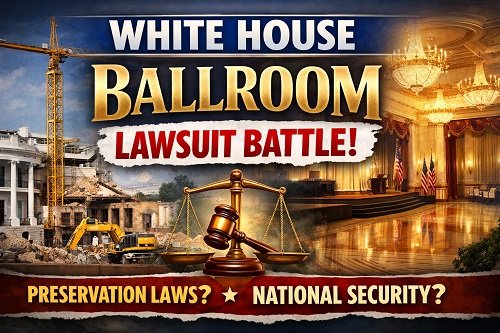
The Lawsuit and Legal Challenge
The legal dispute began when the National Trust for Historic Preservation filed a lawsuit in late 2025. The organization claimed that the administration bypassed key legal requirements, including:
- Lack of congressional approval
- Failure to follow environmental and preservation review laws
- Insufficient public consultation
The lawsuit argues that such a major alteration to a historic federal property cannot be carried out solely under presidential authority. According to the plaintiffs, federal laws like the National Environmental Policy Act require detailed review before such construction can proceed.
Court Rulings and Injunction
In March 2026, U.S. District Judge Richard J. Leon issued a major ruling. He ordered a temporary halt to the ballroom construction, stating that the administration had not clearly shown it had the authority to proceed without Congress.
The judge also questioned whether demolishing the East Wing could realistically be considered a simple “alteration,” signaling skepticism about the administration’s legal justification.
However, the ruling included a partial exception: work related to safety and security could continue.
Appeals Court Developments
The case quickly moved to the U.S. Court of Appeals for the D.C. Circuit. In April 2026, the appeals court allowed construction to continue temporarily while reviewing the lower court’s decision.
This decision did not settle the case but paused the injunction to give the administration time to argue its position. The court also asked for clarification on whether halting construction would pose real security risks.
National Security Argument
One of the most unusual aspects of this case is the government’s claim that stopping construction could threaten national security.
According to the administration, the project includes not just a ballroom but also underground facilities such as:
- Reinforced bunkers
- Emergency response areas
- Medical and security infrastructure
Officials argue that leaving the site partially built could expose the White House to risks. However, critics and preservation groups strongly dispute this claim, saying the security argument is exaggerated and used to justify fast-tracking the project.
Key Issues at the Center of the Case
The lawsuit revolves around a few central questions:
- Does the President have unilateral authority?
The administration claims broad power to modify the White House. Opponents argue that major structural changes require congressional approval. - Were preservation laws ignored?
The lawsuit alleges that required environmental and historical reviews were skipped or rushed. - Is national security a valid justification?
Courts are now examining whether the security claims are genuine or overstated.
Current Status (April 2026)
As of now, construction is temporarily allowed to continue while the courts reconsider key aspects of the case. The final outcome is still uncertain, and the dispute could potentially reach the U.S. Supreme Court if unresolved.
Meanwhile, the project remains deeply divisive. Preservationists see it as a dangerous precedent, while supporters view it as a modernization effort.
Conclusion
The White House ballroom lawsuit is more than just a construction dispute. It highlights a larger conflict between modernization and preservation, executive power and legal limits.
What makes this case stand out is how it mixes architecture, politics, and law into one complex issue. The final decision will not only determine the fate of the ballroom but could also set an important precedent for how future changes to historic government buildings are handled.
For now, the cranes remain at work—but the legal battle is far from over.