Radar detectors are electronic devices designed to alert drivers when law enforcement officers are using radar guns to measure vehicle speeds. They have been a fixture of American driving culture for decades, generating ongoing debate between motorists who view them as legitimate tools for situational awareness and law enforcement advocates who argue they enable speeding. The legal status of radar detectors in the United States is not uniform — it varies significantly depending on the state, the type of vehicle being operated, and the specific federal highway system being traveled. Understanding the complete legal landscape for radar detector use requires examining federal law, state-by-state regulations, military installation rules, and the important distinction between radar detectors and radar jammers.
Federal Law on Radar Detectors
At the federal level, the most directly applicable law governing radar detectors is the Federal Highway Administration’s regulation prohibiting radar detectors in commercial motor vehicles operating on public roads. Under 49 C.F.R. Section 392.71, commercial motor vehicles — trucks with a gross vehicle weight rating exceeding 10,000 pounds and buses designed to transport more than eight passengers — are prohibited from using radar detectors on all public roads. This federal prohibition applies regardless of what state the commercial vehicle is operating in, creating a uniform national ban for the commercial vehicle sector.
For private passenger vehicles, federal law does not impose a blanket prohibition on radar detectors. The regulation of radar detector use in non-commercial vehicles is left entirely to state law, creating the patchwork of regulations that drivers across the country must navigate.
State-by-State Legal Status
The legal status of radar detectors for private passenger vehicles varies considerably across the fifty states, though the majority of states permit their use.
Virginia is the most notable exception — it is the only U.S. state that completely prohibits the use and possession of radar detectors in all vehicles, including private passenger cars. Virginia Code Section 46.2-1079 makes it illegal to use or possess a radar detector in any motor vehicle on Virginia’s highways, and violations are civil traffic infractions carrying fines. This prohibition has been in place for decades and represents Virginia’s determination that radar detectors primarily facilitate speeding rather than serve legitimate driver safety purposes.
Washington D.C. similarly prohibits radar detectors in all vehicles within the District’s jurisdiction, making the nation’s capital another significant exception to the general permissibility of radar detector use.
All other U.S. states permit radar detector use in private passenger vehicles, though some impose restrictions on windshield mounting that affect where the device can be placed in the vehicle. California and New Jersey, for example, prohibit attaching devices to windshields in ways that obstruct the driver’s view, which can affect how a radar detector is mounted even though the device itself is legal in those states.
The Military Installation Exception
Federal law and military installation regulations prohibit radar detectors on military bases and installations throughout the country. The Department of Defense regulations governing vehicle operation on military property prohibit radar detector use, and this prohibition applies to both military personnel and civilian visitors operating vehicles on installation property. Drivers who regularly access military installations should be aware that their otherwise legal radar detector must be turned off or removed when entering those areas.
Radar Detectors vs. Radar Jammers: A Critical Legal Distinction
One of the most important legal distinctions in this area involves the difference between radar detectors — which passively receive radar signals — and radar jammers — which actively transmit signals designed to interfere with law enforcement radar equipment. This distinction is legally critical because the two devices occupy entirely different legal categories.
Radar jammers — devices that actively transmit signals to interfere with police radar — are illegal under federal law under the Communications Act of 1934 and regulations administered by the Federal Communications Commission. Active radar jamming constitutes unlawful interference with federal communications and is prohibited regardless of what state the driver is in. Criminal penalties for active radar jamming include fines and potential imprisonment, and the FCC has actively pursued enforcement actions against radar jammer manufacturers and distributors.
Laser jammers — devices that interfere with LIDAR speed measurement systems — occupy a slightly different legal space. While federal law does not specifically prohibit laser jammers in the same way it prohibits radar jammers, many states have enacted specific prohibitions on laser jammer use, and the devices exist in a complex legal grey zone that varies considerably by jurisdiction.
Windshield Mounting and Obstruction Laws
Even in states where radar detectors are legal, their placement within the vehicle must comply with applicable laws governing windshield obstruction and dashboard mounting. Most states prohibit attaching objects to windshields in ways that obstruct the driver’s view of the road. California Vehicle Code Section 26708 specifically addresses objects on windshields and has been applied to radar detector mounting. A detector mounted in the center of the windshield in a location that obstructs forward vision can result in a separate citation for windshield obstruction even in states where the detector itself is legal.
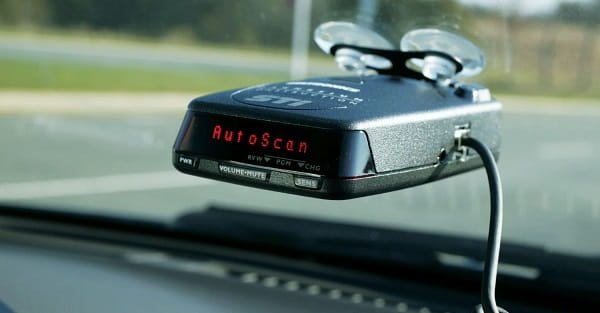
Suction cup mounts that attach to the lower corners of windshields or dashboard mounts that keep the detector below the driver’s primary sight line are generally considered compliant with windshield obstruction laws, though drivers should verify the specific mounting rules in their state.
Law Enforcement Detection of Radar Detectors
Law enforcement agencies in states where radar detectors are prohibited — primarily Virginia — have access to radar detector detectors, devices that can identify whether a driver’s vehicle contains an active radar detector. These devices detect the low-level emissions produced by radar detector circuitry and allow officers to identify prohibited devices from outside the vehicle. Some radar detector manufacturers have responded by producing detector-detector-defeating models that minimize their detectable emissions, though the legal status of any radar detector in Virginia or D.C. remains unchanged regardless of its detectability.
The Bottom Line on Radar Detectors
Radar detectors are legal for use in private passenger vehicles in 48 U.S. states and are prohibited in Virginia and Washington D.C. Federal law prohibits radar detectors in commercial motor vehicles on all public roads regardless of state. Military installations prohibit radar detectors on their property. Radar jammers are federally prohibited regardless of state law. Windshield mounting must comply with state obstruction laws even where the detector itself is legal. Drivers should verify the specific laws of every state they travel through, particularly given that the Virginia prohibition has resulted in significant enforcement activity against out-of-state drivers who were unaware of the state’s unique prohibition.