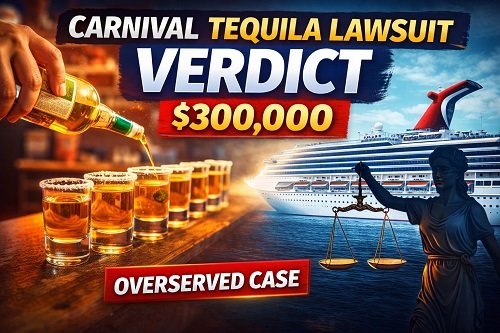
A recent lawsuit involving Carnival Cruise Line has drawn widespread attention after a U.S. jury ruled in favor of a passenger who claimed she was dangerously overserved alcohol during a cruise. The case, often referred to as the “tequila lawsuit,” raises serious questions about safety standards and alcohol service policies on cruise ships.
The verdict, delivered in April 2026, resulted in a $300,000 compensation award to the passenger, marking a rare legal outcome in such cases.
What the Case Was About
The lawsuit centered around an incident that occurred in January 2024 aboard the cruise ship Carnival Radiance. The plaintiff, a 45-year-old woman named Diana Sanders, alleged that she was served more than a dozen shots of tequila—at least 14—within an eight-hour period.
According to court filings, the excessive alcohol consumption led to a severe fall. Sanders reportedly suffered multiple injuries, including a concussion and symptoms consistent with a traumatic brain injury.
Her legal argument was straightforward: the cruise line had a duty to ensure passenger safety and failed by continuing to serve alcohol despite visible intoxication.
Jury Verdict and Compensation
After a week-long federal trial in Miami, the jury ruled in favor of Sanders and awarded her $300,000 in damages.
However, the jury did not place full responsibility on the cruise operator. Instead:
- 60% faultwas assigned to Carnival
- 40% faultwas assigned to the passenger herself
This shared liability reflects a key principle in U.S. personal injury law, where both parties can be held partially responsible for the outcome.
Why This Case Is Unusual
Legal experts note that overservice-of-alcohol cases on cruise ships are extremely difficult to win. Many similar cases are settled privately before reaching a courtroom, or dismissed due to lack of clear evidence.
In this case, Carnival’s defense argued that the plaintiff failed to identify exactly which crew member or bar overserved her.
Despite this, the jury found enough evidence to hold the company accountable. This makes the verdict particularly significant, as it shows that cruise lines can still be held responsible even without pinpointing a specific employee.
Carnival’s Response
Following the verdict, Carnival Cruise Line stated that it disagrees with the jury’s decision and is considering further legal action. The company indicated it may seek a new trial or file an appeal.
This response suggests that the legal battle may not be fully over, and the case could continue in higher courts.
Broader Legal and Safety Implications
This lawsuit highlights a larger issue within the cruise industry—how alcohol is managed onboard. Cruise ships often promote a relaxed, party-like environment, with unlimited drink packages and multiple bars.
However, this case raises an important question:
At what point does service become negligence?
Under maritime law, cruise operators have a duty of “reasonable care” toward passengers. This includes monitoring alcohol consumption and preventing situations that could lead to harm.
The verdict reinforces that:
- Overserving alcohol can be considered negligence
- Cruise lines may be held liable for injuries linked to intoxication
- Passenger responsibility still plays a role in legal outcomes
Impact on the Cruise Industry
The outcome of this case could influence how cruise companies operate in the future. Experts believe it may lead to:
- Stricter alcohol service policies
- Better staff training to identify intoxicated passengers
- Increased monitoring in bars and lounges
- Possible limits on drink packages
For passengers, it also serves as a reminder that personal responsibility matters, even in environments designed for leisure.
Final Thoughts
The Carnival tequila lawsuit verdict is more than just a compensation case—it’s a signal to the entire cruise industry. It shows that while passengers are expected to act responsibly, companies cannot ignore their duty of care.
With $300,000 awarded and shared liability established, the case sets a precedent that could shape future legal battles involving cruise safety and alcohol service.
As the story develops, especially if an appeal is filed, it may further define where the line between personal choice and corporate responsibility truly lies.