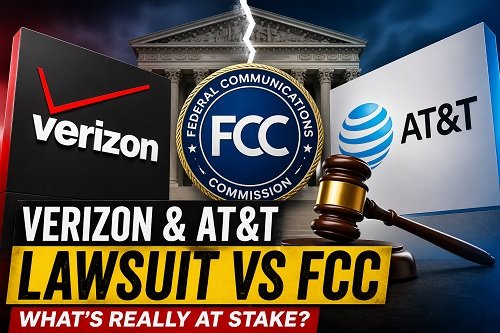
The legal battle between Verizon Communications, AT&T, and the Federal Communications Commission has quietly become one of the most important regulatory fights in the telecom industry. At its core, the case is not just about fines—it’s about how much power a federal agency should have over private companies.
Background of the Dispute
The conflict began when the FCC imposed heavy penalties on major wireless carriers, including Verizon and AT&T, for allegedly mishandling sensitive customer data. The issue centered on location data—information that can reveal where a person travels, lives, and spends time.
In 2024, the FCC fined telecom companies nearly $200 million in total, accusing them of sharing real-time location data with third parties without proper safeguards. Verizon faced a penalty of around $47 million, while AT&T was fined about $57 million.
According to regulators, this data was sold to aggregators and, in some cases, ended up in the hands of unauthorized actors such as bounty hunters. The FCC argued that this violated strict privacy rules designed to protect customer information.
Why Verizon and AT&T Challenged the FCC
Both companies paid the fines but did not accept the ruling quietly. Instead, they challenged the FCC in court. Their argument is not just about money—it’s about the legal process itself.
The telecom giants claim that the FCC’s enforcement system is unconstitutional. Specifically, they argue that:
● The FCC acts as investigator, prosecutor, and judge all at once
● Companies are forced to pay fines before fully challenging them
● The process limits their right to a jury trial
This challenge became stronger after a separate 2024 Supreme Court decision that restricted how federal agencies can impose penalties internally.
The Supreme Court Steps In
Because lower courts gave mixed rulings, the case eventually reached the Supreme Court of the United States. This turned the dispute into a much bigger issue—one that could reshape regulatory power across industries.
During hearings, the court examined whether the FCC’s system violates constitutional rights. Verizon and AT&T argued that penalties should only be imposed through a proper court trial, not internal agency proceedings.
However, early signals from the justices suggest skepticism toward the telecom companies’ claims. Some judges pointed out that FCC fines are not final until enforced in court, meaning companies still have a chance to challenge them legally.
The FCC’s Position
The FCC has defended its authority strongly. It argues that its enforcement process has been used for decades and is essential for regulating fast-moving industries like telecommunications.
From the FCC’s perspective:
● The fines are necessary to protect consumer privacy
● The process allows companies to challenge penalties later in court
● Weakening enforcement would reduce accountability
The agency also emphasizes that location data is extremely sensitive and misuse could put individuals at risk.
Broader Context: Data Privacy Concerns
This lawsuit is happening at a time when data privacy is becoming a major global issue. Telecom companies handle vast amounts of personal data, including call records, browsing activity, and location tracking.
AT&T, for example, has faced multiple data-related controversies. It agreed to a $13 million settlement with the FCC over a separate data breach affecting millions of customers.
It also settled a much larger $177 million class-action lawsuit tied to data breaches in 2024.
These incidents add pressure on regulators to enforce stricter rules—and on companies to improve data protection.
Why This Case Matters
This case goes far beyond Verizon and AT&T. Its outcome could affect how all federal agencies operate, not just the FCC.
If the court rules in favor of the telecom companies:
● Agencies may lose power to issue penalties internally
● More cases would need full court trials
● Regulatory enforcement could slow down significantly
On the other hand, if the FCC wins:
● Agencies will retain strong enforcement authority
● Companies may face faster penalties for violations
● Privacy regulations could become stricter
What Happens Next
A final decision from the Supreme Court is expected soon.
Whatever the outcome, the ruling will likely set a precedent for how government agencies regulate large corporations in the future.
For now, the case highlights a simple but powerful tension—balancing corporate rights with public protection. Verizon and AT&T want more legal safeguards. The FCC wants stronger oversight.
Somewhere in between, the court will decide how far regulatory power should go in the digital age.