The transmission issues linked to General Motors have turned into one of the most talked-about automotive legal battles in recent years. Thousands of vehicle owners across the United States have raised complaints, claiming that certain GM models suffer from serious transmission defects. What started as scattered reports has now grown into a major lawsuit that could have long-term consequences for both the company and its customers.
What Is the GM Transmission Lawsuit About?
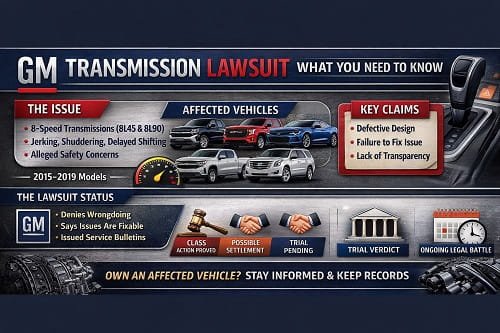
At the center of the controversy is GM’s 8-speed automatic transmission, commonly referred to as the 8L45 and 8L90. Drivers began reporting problems such as harsh shifting, delayed acceleration, jerking movements, and in some cases, complete transmission failure.
Many owners say these issues didn’t just affect comfort—they raised safety concerns. Imagine your car hesitating while merging onto a highway or suddenly jerking in traffic. That’s the kind of experience that led people to take legal action.
The lawsuit alleges that GM knew about these defects but continued selling affected vehicles without properly fixing the issue or informing buyers.
Which Vehicles Are Affected?
The problem isn’t limited to one model. Several popular vehicles from GM brands are part of the lawsuit, including:
- Chevrolet Silverado
- Chevrolet Camaro
- GMC Sierra
- Cadillac Escalade
- Cadillac CTS
These models were mostly produced between 2015 and 2019, though some complaints extend beyond those years.
Because these are high-volume vehicles, the number of affected customers is quite large. That’s why the case has gained national attention.
What Are Customers Claiming?
The lawsuit mainly focuses on three key allegations:
- Defective Design
Owners argue that the transmission itself is flawed, not just suffering from minor wear and tear. - Failure to Fix the Issue
Even after multiple service visits, many drivers say the problem keeps coming back. Some claim dealerships only applied temporary fixes like fluid flushes. - Lack of Transparency
The lawsuit states that GM was aware of the issue but did not disclose it to buyers at the time of sale.
These claims, if proven, could mean GM violated consumer protection laws.
GM’s Response
General Motors has not admitted wrongdoing. The company has argued that:
- The transmission issues are not universal
- Many problems can be fixed through maintenance
- The vehicles are safe to drive
GM has also pointed out that it has issued technical service bulletins (TSBs) to help dealerships address customer complaints.
However, for many customers, these measures have not been enough.
Legal Progress and Current Status
The case has been moving through the U.S. court system for a few years now. It has gone through several stages, including motions to dismiss and certification discussions.
At one point, a judge allowed parts of the lawsuit to proceed, which was seen as a win for vehicle owners. This meant the claims had enough merit to be examined more closely in court.
There have also been talks of settlements, but as of now, a final nationwide resolution has not been fully concluded.
What Could Happen Next?
There are a few possible outcomes:
- Settlement
GM could agree to compensate affected owners without admitting fault. This is common in large consumer lawsuits. - Trial Decision
If the case goes to trial, a court could decide whether GM is liable and what damages should be paid. - Extended Legal Battle
These cases can take years, especially when large sums of money and millions of vehicles are involved.
What Should Vehicle Owners Do?
If you own a GM vehicle from the affected years and have experienced transmission problems, there are a few practical steps:
- Keep all service records and repair bills
- Report issues to your dealership and get written documentation
- Check if your vehicle is included in any active class-action lawsuit
- Stay updated on recalls or service advisories
Even if the case is not finalized yet, having proper records can help if compensation becomes available later.
Why This Case Matters
This lawsuit is not just about one company. It highlights a bigger issue in the auto industry—how manufacturers handle known defects.
Modern vehicles are more complex than ever. When something like a transmission fails, it’s not just expensive—it can affect safety and trust. Cases like this push companies to be more transparent and responsive.
For consumers, it’s a reminder to stay informed and speak up when something doesn’t feel right with their vehicle.
Final Thoughts
The GM transmission lawsuit is still unfolding, but it has already made an impact. It has brought attention to a widespread issue and forced one of the world’s largest automakers to answer tough questions.
Whether it ends in a settlement or a courtroom verdict, one thing is clear: drivers today expect reliability, honesty, and accountability—and they are willing to fight for it when those expectations aren’t met.