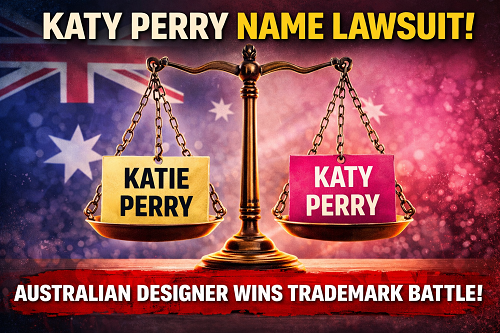
A long-running legal battle over the use of the name “Katy Perry” has finally reached its conclusion in Australia. The dispute involved global pop star Katy Perry and an Australian fashion designer named Katie Perry.
After years of courtroom arguments and appeals, the High Court of Australia delivered a decisive ruling that favored the designer. The case, which lasted more than a decade, highlights how trademark law works and how even a global celebrity can face legal limits when it comes to brand names.
How the Trademark Dispute Began
The conflict traces back to the late 2000s when Katie Perry, a Sydney-based designer, launched her own clothing label. She registered the trademark “Katie Perry” in Australia for fashion products such as clothing and apparel.
Around the same time, Katy Perry was becoming a global music sensation following the success of her hit song “I Kissed a Girl.” As her fame grew, the singer began selling branded merchandise including T-shirts, jackets, and other clothing items during tours and through online stores.
The problem emerged when this merchandise was sold in Australia using the name “Katy Perry.” The designer argued that this created confusion in the fashion market and violated her trademark rights, since she had already registered the name for clothing in the country.
Because both names sound almost identical, the dispute quickly became a serious legal issue.
Legal Battle That Lasted Over a Decade
The disagreement eventually turned into a formal lawsuit in Australian courts. Katie Perry claimed that the pop star’s merchandise was infringing on her trademark and damaging her brand.
The singer’s legal team argued that the name Katy Perry was globally recognized as belonging to the famous musician. They suggested that customers would naturally associate the name with the singer rather than a small fashion label.
However, the designer maintained that trademark law is based on who registers a brand first within a specific market. Since she had already secured the trademark in Australia, she argued that the pop star should not be allowed to use the same name for clothing within that country.
The case moved through multiple levels of courts, with different rulings and appeals over the years. At one stage, the designer even won compensation after the court found that the singer’s merchandise had breached trademark rules.
The legal battle continued until the matter reached Australia’s highest court.
High Court of Australia Delivers Final Verdict
In 2026, the High Court of Australia delivered its final decision in the case. The court ruled in favor of the Australian designer.
Judges concluded that Katie Perry had legitimately registered the trademark for clothing long before the singer’s merchandise entered the Australian fashion market. Because of that earlier registration, the designer had the legal right to protect the brand name within the country.
The ruling also rejected the argument that the singer’s worldwide fame automatically gives her the right to override a local trademark. Instead, the court emphasized that trademark rights are territorial and must be respected within each jurisdiction.
As a result, the designer retained full control over the “Katie Perry” clothing trademark in Australia.
Why the Case Drew Global Attention
The lawsuit attracted widespread attention for several reasons. First, it involved one of the world’s most famous pop stars facing a legal challenge from a relatively small independent designer.
This created a classic “David versus Goliath” situation, where a small business owner stood up against a global celebrity brand.
Second, the case highlighted an interesting legal reality: celebrity fame does not always guarantee control over a brand name. Trademark protection depends heavily on registration, timing, and location.
Another reason for the interest was the similarity between the two names. The only difference between “Katy” and “Katie” is a single letter, yet that small difference became the center of a major international legal dispute.
Impact on Celebrities and Branding
Legal experts say the case may influence how celebrities manage trademarks in different countries. Many public figures use stage names as part of their commercial identity, but those names may already be registered by other businesses in certain markets.
In fact, Katy Perry’s real name is Katheryn Elizabeth Hudson, and “Katy Perry” is a stage name she adopted early in her career.
The case serves as a reminder that artists and brands must secure trademarks carefully if they plan to sell products globally.
Companies often register trademarks in multiple countries to avoid exactly this kind of conflict.
Conclusion
The Katy Perry name lawsuit shows how complex trademark law can become when global fame intersects with existing business rights. Despite being one of the most recognizable music stars in the world, Katy Perry ultimately lost the legal battle in Australia because the designer had registered the trademark first.
The final ruling by the High Court of Australia confirms that trademark ownership is determined by legal registration rather than popularity. For businesses and celebrities alike, the case highlights the importance of protecting brand names early and across different markets.