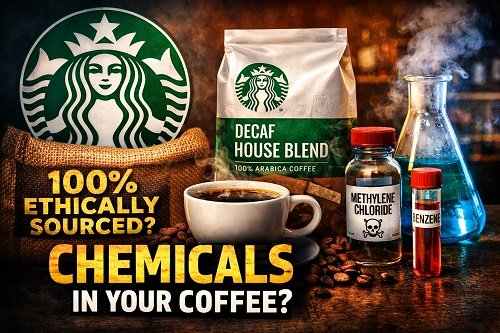
In early 2026, a class-action lawsuit was filed in the United States against the global coffee chain Starbucks. The case has drawn attention because it raises questions about the company’s marketing claims and the chemical processes used in some of its decaffeinated coffee products. The lawsuit mainly focuses on two issues: the presence of certain chemical compounds in decaffeinated coffee and claims related to ethical sourcing practices.
Although the case is still in its early legal stages, it has sparked discussion among consumers and industry experts about transparency in the coffee industry and how companies communicate product information to customers.
Background of the Lawsuit
The lawsuit was filed by a group of consumers who argue that Starbucks misled customers about some aspects of its coffee products. According to the complaint, the company advertises its coffee as “100% Arabica coffee” and promotes a strong commitment to responsible sourcing.
The plaintiffs claim these statements could lead customers to believe that Starbucks coffee is produced and processed without certain chemical methods or questionable supply chain practices.
The lawsuit does not claim that Starbucks coffee violates food safety regulations. Instead, it argues that the company did not clearly disclose certain details about how some products are processed or sourced.
The Issue of VOCs in Decaffeinated Coffee
One of the central points in the lawsuit involves VOCs, or volatile organic compounds. These are chemical substances that easily evaporate at room temperature and are commonly used in various industrial and food processing applications.
The complaint alleges that independent testing found traces of certain chemicals linked to the decaffeination process in some Starbucks decaf coffee products. Among the chemicals mentioned in the lawsuit are:
- Methylene chloride
- Benzene
- Toluene
These substances are sometimes associated with industrial solvents. In coffee production, a compound such as methylene chloride has historically been used in some decaffeination techniques.
The plaintiffs argue that consumers who purchase decaffeinated coffee labeled simply as coffee beans might not expect any chemical solvent involvement in the process.
However, it is important to understand that the use of certain solvents in decaffeination is regulated by food safety authorities, and the presence of extremely small trace amounts can still fall within legal limits.
How Decaffeination Works
To understand the issue better, it helps to look at how decaffeinated coffee is made.
Coffee beans naturally contain caffeine. To remove it, manufacturers use several methods. Some of the most common techniques include:
Solvent-based method
A chemical solvent such as methylene chloride is used to extract caffeine from the beans. After the process, the beans are washed and roasted.
Swiss Water Process
This method uses water and filtration instead of chemical solvents.
Carbon dioxide method
High-pressure carbon dioxide is used to remove caffeine while preserving flavor.
Different coffee producers choose different methods depending on cost, efficiency, and flavor preservation.
The lawsuit claims Starbucks did not clearly explain which process is used for certain decaffeinated products.
Ethical Sourcing Allegations
Another key part of the case involves Starbucks’ well-known ethical sourcing claims.
The company promotes a program called C.A.F.E. Practices, which stands for Coffee and Farmer Equity. This internal system is designed to ensure that coffee farmers meet certain environmental, labor, and quality standards.
Starbucks has often stated that its coffee is “100% ethically sourced.”
The lawsuit argues that this claim may be misleading because investigations have reported issues at some certified farms. These reports included concerns about labor conditions, wages, and worker safety.
According to the plaintiffs, if such issues exist within certified farms, the claim of universal ethical sourcing could be misleading for consumers who rely on those assurances when choosing coffee brands.
Starbucks’ Response
Starbucks has rejected the allegations presented in the lawsuit.
The company maintains that its coffee meets safety standards and that its sourcing program includes regular monitoring and auditing of farms. Starbucks representatives have also stated that the lawsuit misrepresents how its sourcing system works.
The company says it works closely with farmers and independent organizations to improve sustainability, labor conditions, and environmental protection in coffee-producing regions.
Starbucks has also emphasized that food safety regulations strictly control decaffeination processes used in the coffee industry.
What Happens Next
At this stage, the lawsuit is still going through the early steps of the legal process. Courts will review the claims, evidence, and responses from both sides before deciding whether the case can proceed as a class action.
Legal cases like this often take months or even years to reach a final outcome.
For consumers, the case highlights broader questions about transparency in food production, marketing language used by major brands, and how much information companies should provide about manufacturing processes.
Regardless of the final decision, the discussion around this lawsuit reflects a growing public interest in understanding exactly how everyday products—like coffee—are produced and marketed.