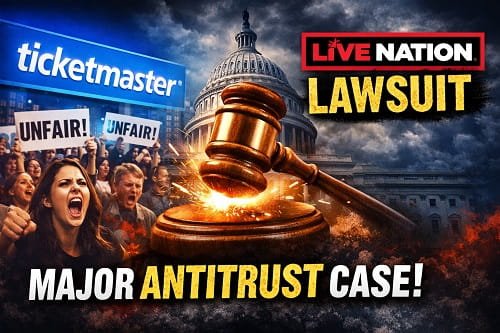
The ongoing legal battle involving Live Nation Entertainment and its subsidiary Ticketmaster has become one of the most significant antitrust cases in the entertainment industry. Governments, regulators, and fans have raised concerns about whether the company holds too much power over concert ticket sales and live event venues. The lawsuit has drawn global attention because it could reshape how concerts are promoted, tickets are sold, and artists interact with fans.
Here is a detailed look at the lawsuit, the accusations against Live Nation, and the most recent developments.
Background of the Live Nation Antitrust Lawsuit
The case began in May 2024, when the U.S. Department of Justice (DOJ) filed a major antitrust lawsuit against Live Nation and Ticketmaster. The lawsuit was supported by dozens of U.S. states and aimed to challenge the company’s dominance in the live entertainment industry.
According to the DOJ, Live Nation used its market power to control concert promotion, venue management, and ticket sales, creating what regulators called an illegal monopoly. The government argued that this dominance harmed fans, artists, and smaller competitors by reducing competition and driving up ticket prices.
The lawsuit even sought a drastic solution: breaking up Live Nation and Ticketmaster, reversing their 2010 merger that created the current entertainment giant.
Why Live Nation Was Accused of Monopolizing the Industry
Authorities claim Live Nation controls multiple parts of the live entertainment ecosystem. The company is the largest concert promoter in the United States and also owns Ticketmaster, the biggest ticket-selling platform.
Regulators say this vertical integration allowed the company to dominate the industry in several ways:
- Forcing venues to use Ticketmaster’s ticketing services
- Using exclusive contracts to block competitors
- Limiting concert access to venues that work with rival ticket sellers
- Charging high service fees on tickets
In some cases, prosecutors argued that venues that chose another ticket provider would lose concerts promoted by Live Nation, which discouraged competition.
Because Live Nation controls promotion, venues, and ticketing, critics say it has the ability to influence pricing and limit options for artists and fans.
The 2022 Taylor Swift Ticketmaster Controversy
Public anger toward Ticketmaster grew dramatically after the 2022 presale for Taylor Swift’s Eras Tour. The ticketing system crashed due to overwhelming demand, leaving millions of fans unable to buy tickets.
The incident triggered investigations from lawmakers and regulators. It also intensified scrutiny of Ticketmaster’s market power and helped push authorities toward filing the antitrust lawsuit.
Many policymakers argued that the failure highlighted how a single company controlling most ticket sales could create problems across the entire entertainment market.
Trial Begins in 2026
After months of legal preparation, the case finally reached court in March 2026, when a federal trial began in New York.
The trial was expected to determine whether Live Nation violated antitrust laws and whether regulators could force structural changes to the company.
However, just one week after the trial started, a surprising development occurred.
Surprise Settlement with the U.S. Department of Justice
In March 2026, Live Nation reached a tentative settlement with the DOJ that could resolve part of the case.
Under the agreement, several reforms were proposed:
- Live Nation would create a $280 million settlement fundfor participating states
- Ticketmaster must allow rival ticket platformsto integrate with its system
- Service fees for certain venues would be capped at 15% of ticket prices
- The company must give up exclusive booking rights at 13 amphitheaters
- Long-term exclusivity contracts with venues would be restricted
Supporters say these changes could increase competition and help lower ticket prices for fans.
However, the settlement also allows Live Nation to keep Ticketmaster, meaning the company would avoid being broken up.
States Push Back Against the Settlement
Despite the federal settlement, the legal battle is far from over.
More than two dozen state attorneys general have rejected the deal, arguing that it does not go far enough to address Live Nation’s market power.
Critics say the agreement only introduces minor reforms and does not fundamentally change the structure of the industry. Some states want the courts to consider stronger actions, including forcing the company to separate Ticketmaster from Live Nation.
As a result, several states plan to continue litigation independently, meaning the case could still go on for months or even years.
Other Lawsuits and Legal Pressure
The antitrust case is not the only legal challenge facing Live Nation.
In recent years, the company has also dealt with:
- Consumer lawsuitsclaiming fans were overcharged for tickets
- Shareholder lawsuitsaccusing the company of misleading investors about regulatory risks
- Federal Trade Commission investigationsinto ticket resale practices and hidden fees
These legal battles highlight growing concern about the structure of the ticketing industry and the role of major entertainment corporations.
What Happens Next?
The future of the Live Nation lawsuit remains uncertain. If the federal settlement is approved, it may introduce new rules for ticketing platforms and venue contracts. However, because several states oppose the agreement, the court may still have to decide major parts of the case.
If regulators ultimately succeed in proving monopolistic behavior, the court could impose stronger remedies, including structural changes to the company.
For fans, artists, and promoters, the outcome could determine how concert tickets are sold and priced for years to come.
Conclusion
The Live Nation lawsuit represents one of the most important antitrust battles in the entertainment industry. Governments argue that the company’s control over promotion, venues, and ticket sales harms competition and raises prices for fans.
While a tentative settlement with the U.S. Department of Justice proposes reforms and financial penalties, many states believe it does not go far enough. As a result, the legal fight is likely to continue.
The final outcome could reshape the live music business and determine whether the current structure of the ticketing industry remains intact or undergoes major changes.