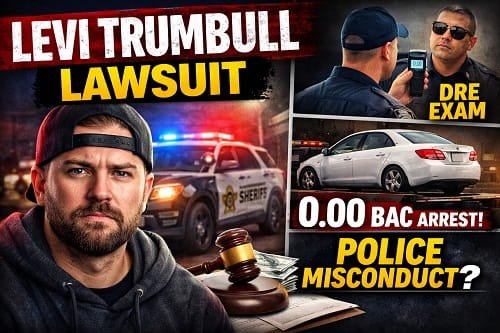
The Levi Trumbull case has grown from a routine traffic stop into a widely discussed legal story about police authority and individual rights. What makes it stand out is simple but striking—a DUI arrest followed by a 0.00 blood alcohol result, raising immediate questions about how and why the arrest happened in the first place.
At first glance, it looks straightforward. But once you look closer, the situation becomes more layered. Internal findings, procedural questions, and the officer’s decisions during the stop have all added depth to the case. As things stand, it is shaping into a potential civil rights battle centered on probable cause and accountability.
What Happened: The Incident Explained
The incident took place on March 29, 2025, in Frederick County, Maryland.
Levi Trumbull, known for documenting police interactions, was pulled over by a sheriff’s deputy for allegedly running a red light. What started as a normal traffic stop quickly escalated.
- The deputy asked him to perform field sobriety tests
- Trumbull refused, which is within his legal rights
- He was then arrested on suspicion of DUI
After the arrest, a breathalyzer test was conducted. The result showed 0.00 BAC, confirming no alcohol in his system.
Despite that, the arrest had already been made, and his vehicle was impounded.
Court Outcome: Charges Dismissed
The legal proceedings that followed were brief.
On May 8, 2025, the traffic-related charges were dismissed in court, reportedly because the deputy did not appear.
This meant:
- No conviction
- No penalties
- The case closed at the traffic level
However, a dismissal does not automatically mean the arrest was unlawful. It simply means the charges were not pursued further.
Internal Findings: A Critical Detail
An internal review by the Frederick County Sheriff’s Office reportedly found that the arresting deputy violated departmental policies during the encounter.
This detail matters more than it may seem.
Internal findings like this often play a key role in civil rights cases because they:
- Provide official acknowledgment of procedural errors
- Strengthen claims of improper conduct
- Add credibility to a potential lawsuit
While this does not itself prove a constitutional violation, it creates a strong foundation for legal action.
The DRE Evaluation: Where Things Turn Complex
After the breath test showed 0.00 BAC, the deputy reportedly requested a Drug Recognition Expert (DRE) evaluation to check for possible drug impairment.
Here’s the key point:
- A DRE evaluation is voluntary
- Trumbull chose to refuse the test, which is his legal right
This moment is likely to become central in any courtroom argument.
From one side, it may appear that the officer was continuing to search for justification. From the other, it may be seen as a reasonable step, since DUI laws also include drug impairment—not just alcohol.
The Core Legal Question: Probable Cause
Everything in this case comes down to one issue:
Did the officer have probable cause at the time of arrest?
Courts do not judge an arrest based only on what is discovered later. Instead, they examine whether the officer’s decision was reasonable at that exact moment.
Points That Raise Questions
- 00 BAC result
- Dismissed charges
- Internal policy violations
Points That May Support the Officer
- Alleged traffic violation
- Refusal of field sobriety tests
- Possibility of drug impairment
Because of this, the case is not simply about innocence or guilt—it’s about whether the decision to arrest was justified under the law.
Financial Impact: More Than Just Legal Fees
The arrest also had immediate financial consequences.
Trumbull reportedly paid over $367 in impound fees to retrieve his vehicle. While small compared to a larger damages claim, this type of expense is important in legal cases because it shows:
- Direct financial loss
- Immediate impact of the arrest
- Measurable harm
These details often become part of a broader compensation claim.
Potential Lawsuit: What It Could Involve
Although the situation has not yet fully played out in court, the case is expected to move toward a civil rights lawsuit.
If filed, it would likely include claims such as:
- False arrest
- Unlawful detention
- Violation of civil rights under Section 1983
The reported damages claim is around $1 million, which could cover:
- Emotional distress
- Financial losses
- Legal costs
- Reputational harm
Whether the case proceeds to trial or settles earlier will depend heavily on the available evidence.
Evidence That Could Decide the Case
Modern cases like this often come down to documentation.
Key evidence may include:
- Bodycam footage
- Breathalyzer records
- Internal investigation reports
- Officer testimony
Among these, video footage can be especially powerful because it shows exactly how the situation unfolded in real time.
Why This Case Is Getting Attention
The reason this case continues to attract attention is simple.
It raises a question that affects everyone:
Can someone be arrested without clear evidence of wrongdoing—and if so, where is the line?
The combination of a 0.00 BAC result, policy violations, and continued investigation during the stop has made people look more closely at how such decisions are made.
What Happens Next
There are a few possible directions this case could take:
- A formal lawsuit is filed, leading to a court battle
- An early settlement, avoiding a trial
- No further legal action, leaving the case as a public debate
Each outcome depends on how strongly both sides can support their arguments.
Final Take
The Levi Trumbull case may look simple on the surface, but it isn’t.
It’s not just about a DUI arrest or a breath test result. It’s about how decisions are made in the moment—under pressure—and whether those decisions stay within the boundaries of the law.
At its core, the case asks one difficult question:
Was this a justified arrest based on real suspicion, or did the situation continue beyond what the evidence supported?
That question will ultimately decide everything if the case moves forward in court.