

The U.S. Supreme Court on Wednesday ruled unanimously that GEO Group cannot immediately appeal a lower court decision that denied the private prison operator governmental immunity in a class-action lawsuit brought by immigrant detainees.
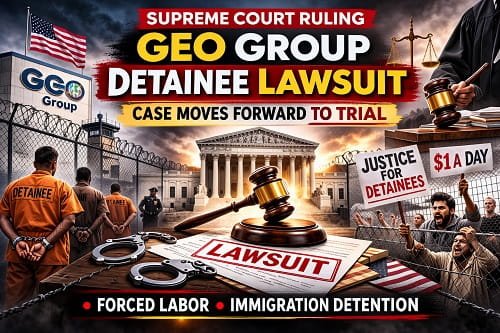
The case centers on allegations that detainees held at a GEO-run immigration facility in Aurora, Colorado, were forced to work for as little as $1 a day under threat of punishment, including solitary confinement. The lawsuit, first filed in 2014, accuses the company of labor trafficking and other violations of federal law.
In its ruling, the Supreme Court agreed with the Denver-based 10th U.S. Circuit Court of Appeals, which had earlier found that GEO was not entitled to an immediate appeal. The justices said the lower court’s order allowing the case to proceed to trial was only an incremental step in the litigation process and therefore not eligible for early review.
While the ruling turns on a technical procedural issue, it carries major implications for federal contractors nationwide.
Why the Decision Matters
Under U.S. law, the federal government generally enjoys immunity from lawsuits related to its core governmental functions. In some circumstances, that protection can extend to private contractors acting on the government’s behalf. GEO argued that because it operated the detention center under contract with Immigration and Customs Enforcement (ICE), it should be shielded from the lawsuit.
The Supreme Court rejected that argument at this stage of the case.
Writing for the court, Elena Kagan explained that governmental immunity is a legal defense, not an absolute bar to being sued. As a result, the denial of immunity by a trial court does not qualify for immediate appeal.
“A valid defense leads to a judgment of non-liability,” Kagan wrote. “But it does not allow the defendant to escape the varied rigors and costs of legal proceedings.”
The ruling means that contractors who are denied immunity by a trial judge must continue litigating their cases until a final judgment is reached before appealing — a process that can take years.
Details of the Lawsuit
The plaintiffs are former immigration detainees who were awaiting civil deportation proceedings at GEO’s Aurora facility. They allege they were compelled to participate in a work program that involved cleaning, cooking, and other maintenance tasks.
According to the lawsuit, detainees who refused to work were threatened with solitary confinement or other disciplinary measures. The plaintiffs argue that this amounted to forced labor and violated federal anti-trafficking laws.
GEO has consistently denied the allegations, maintaining that its work program was voluntary and lawful. The company has also argued that it was simply following government policy and should therefore be protected from liability.
Impact on Federal Contractors
Legal experts say the decision reinforces a long-standing principle: most defendants get only one appeal, and only after a case is fully resolved.
By blocking GEO’s attempt at an early appeal, the Supreme Court signaled that private companies cannot easily delay trials by invoking immunity claims mid-case. This could affect a wide range of contractors working with federal agencies, particularly in areas like detention, defense, and infrastructure.
For plaintiffs, the ruling clears a major procedural hurdle and allows the case to move closer to trial.
Reactions to the Ruling
GEO, which is based in Florida, did not immediately respond to requests for comment following the decision.
Jennifer Bennett, an attorney representing the detainees, welcomed the ruling. In a statement, she said the court had reaffirmed a basic rule of fairness.
“Government contractors like GEO do not qualify for sovereign immunity,” Bennett said, “and must follow the same ‘one case, one appeal’ principle that applies to everyone else.”
What Comes Next
With the immunity issue settled for now, the case will return to federal trial court in Colorado. Unless GEO ultimately prevails at trial, the company could still appeal later — but only after the lawsuit reaches a final judgment.
For now, the Supreme Court’s decision ensures that the claims of forced labor will be examined in court, rather than dismissed on procedural grounds.