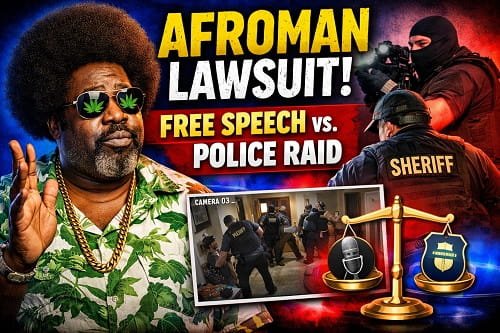
The legal battle involving Afroman has turned into something much bigger than a typical lawsuit. What started as a police raid at his home has now become a national conversation about free speech, privacy, and how far artistic expression can go.
This case isn’t just about one rapper. It’s about the balance between authority and individual rights in a world where everything can be recorded and shared.
The Raid That Sparked It All
In August 2022, officers from the Adams County Sheriff’s Office in Ohio carried out a search warrant at Afroman’s house. The raid was linked to a suspected kidnapping and drug case. But nothing significant was found, and no charges were filed against him.
Normally, that would have ended the matter. But Afroman’s house had security cameras running throughout the property. Every moment of the raid was recorded—officers entering rooms, searching belongings, and interacting with items inside his home.
That footage would soon become the center of the controversy.
When Real Footage Became Music
Instead of keeping the recordings private, Afroman used clips from the raid in his music videos. Songs like “Will You Help Me Repair My Door” and “Lemon Pound Cake” featured actual footage of the officers inside his house.
The videos spread quickly online. Many people found them bold, even funny. Others saw them as a protest against what he believed was an unnecessary invasion of his home.
But the officers involved didn’t see it that way.
Why the Lawsuit Was Filed
In 2023, several deputies who participated in the raid filed a lawsuit against Afroman. Their claims were serious:
- Invasion of privacy
- Emotional distress
- Unauthorized use of their likeness
- Defamation
The officers argued they never consented to being featured in commercial music content. They also claimed the videos portrayed them in a negative light, harming their reputation.
From their side, they were just doing their job under a legal warrant. Ending up in viral music videos crossed a line.
Afroman’s Response: “This Is My Right”
Afroman didn’t step back. If anything, he leaned in harder.
His defense is built on two main points. First, the footage was recorded inside his own home using his own cameras. Second, his music is a form of expression protected under the First Amendment.
He argues that what he created wasn’t just entertainment. It was commentary. A response to what he believes was an unjustified raid.
His legal team also points out that police officers performing official duties usually have limited expectations of privacy—especially inside someone else’s property.
Pre-Trial Drama: Afroman Doubles Down
As the trial approached in March 2026, Afroman made it clear he wouldn’t stay silent.
He released new videos directly addressing the lawsuit. Wearing an American flag suit, he performed songs defending his rights and criticizing the raid. The lyrics were pointed:
“They vandalize my property, my money came up short…”
The videos included not just the raid footage, but also media clips and references to alleged past misconduct by officers.
It wasn’t just music anymore. It felt like a public statement ahead of the courtroom battle.
Support for his stance also came from groups like the Foundation for Individual Rights and Expression (FIRE). The organization warned that a ruling against him could have a “chilling effect” on free speech. According to them, his work clearly falls under artistic expression, parody, and commentary—areas usually protected by law.
The Big Questions This Case Raises
This lawsuit goes beyond one incident. It brings up some tough questions that don’t have easy answers.
Do Police Have Privacy While on Duty?
Officers are public servants. But do they still have personal rights when it comes to how their image is used?
Who Controls Recorded Footage?
If something is captured inside a private home, does the owner have full rights to use it—even commercially?
Where Is the Line Between Criticism and Defamation?
Is Afroman making a statement, or crossing into harmful portrayal? That’s something the court must decide.
What’s at Stake
Legal experts are watching this case closely. If the deputies win, it could open the door for more lawsuits against individuals who criticize law enforcement—especially through creative formats like music or video.
That could discourage people from speaking out.
On the other hand, if Afroman wins, it could strengthen protections for artists and individuals who use real-life events as part of their expression.
The case may set an important precedent for how far free speech can go when it intersects with real people and real situations.
What Happens Next
The trial officially began with jury selection on March 17, 2026. Testimony is expected to last several days, with both sides presenting strong arguments.
The judge will guide the jury through key questions:
- Were Afroman’s statements factual or artistic opinion?
- Did the officers have a reasonable expectation of privacy?
- Does public interest outweigh claims of reputational harm?
The final verdict will likely shape how courts handle similar cases in the future.
Final Thoughts
This isn’t just a celebrity story. It’s a sign of the times.
We live in an era where cameras are everywhere, and content spreads fast. The Afroman lawsuit sits right at that intersection—law, technology, and culture.
Whatever the outcome, one thing is certain: this case will be remembered as a turning point in the ongoing debate over free speech and personal rights.