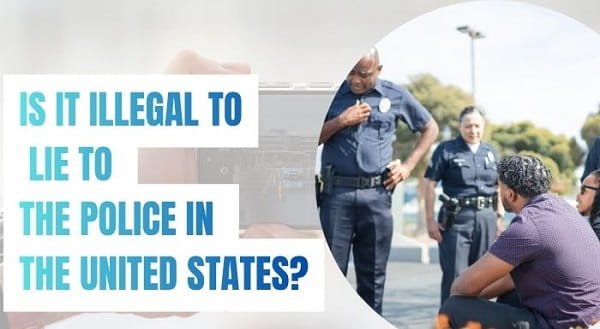
The relationship between honesty and legal obligation when dealing with law enforcement is one of the most frequently misunderstood areas of American law. Most people have a vague sense that lying to the police is wrong, but the specific legal question of whether it is criminal to make false statements to law enforcement is surprisingly nuanced. The answer depends on who you are, what you are lying about, which law enforcement agency you are speaking to, and the specific circumstances of the interaction. In some contexts, lying to law enforcement is a serious federal felony. In others, it is not a crime at all — and you may have a constitutional right to say nothing rather than being required to speak truthfully.
The Fifth Amendment Right to Silence
Before addressing when lying to police is illegal, it is essential to understand the constitutional right that shapes the entire analysis. The Fifth Amendment to the United States Constitution provides that no person shall be compelled in any criminal case to be a witness against themselves. This right — commonly known as the right against self-incrimination — means that you have an absolute constitutional right to remain silent when questioned by law enforcement. You cannot be legally compelled to answer questions that might incriminate you, and invoking your Fifth Amendment right to remain silent is not a crime, cannot be used as evidence of guilt, and is a right that law enforcement must respect.
The practical significance of the Fifth Amendment in this context is profound: because you have the right to remain silent, you are never legally required to answer police questions in most circumstances. This means that the choice you face when questioned by police is not necessarily between telling the truth and lying — it is often between saying nothing and saying something. Exercising your right to remain silent is always legally safe. The legal risk emerges when you choose to speak and make false statements rather than exercising your constitutional right to stay quiet.
Federal Law: 18 U.S.C. Section 1001
The most sweeping and consequential federal statute governing false statements to law enforcement is 18 U.S.C. Section 1001, which makes it a federal felony to knowingly and willfully make any materially false, fictitious, or fraudulent statement or representation in any matter within the jurisdiction of the executive, legislative, or judicial branch of the federal government. This statute applies to false statements made to any federal law enforcement agent — FBI agents, DEA agents, Secret Service agents, IRS investigators, immigration enforcement officers, and any other federal official conducting an investigation.
The reach of Section 1001 is staggering in its breadth. It applies to false statements made during voluntary interviews, during formal investigations, in written submissions to federal agencies, and in any communication with federal officials in their official capacity. Critically, you do not need to be under oath for Section 1001 to apply — unlike perjury, which requires sworn testimony, Section 1001 covers any knowing false statement to a federal official regardless of whether an oath was administered. The famous case of Martha Stewart illustrates the severe consequences of Section 1001 violations — Stewart was convicted and imprisoned not for securities fraud itself but for lying to federal investigators during their inquiry.
Violations of Section 1001 carry penalties of up to five years in federal prison, enhanced to eight years if the false statement relates to terrorism. The statute has been applied broadly and aggressively by federal prosecutors, and the consistent legal advice given by criminal defense attorneys is never to make voluntary statements to federal agents without an attorney present — because any inaccuracy in those statements, even unintentional, creates criminal exposure under Section 1001.
State Laws on Lying to Police
At the state level, the laws governing false statements to law enforcement vary considerably from one jurisdiction to the next. Many states have enacted statutes that criminalize specific categories of false statements to law enforcement, though the scope of these statutes is generally narrower than the federal Section 1001 framework.
Making a false police report — filing a fabricated complaint of a crime, reporting a nonexistent emergency, or providing false information that causes police to investigate a crime that did not occur — is a criminal offense in every U.S. state. False police report statutes are typically classified as misdemeanors for first offenses, with felony enhancement available when the false report causes significant harm, wastes substantial emergency resources, or results in the wrongful arrest of an innocent person. Swatting — making a false emergency call that causes an armed police response — is prosecuted as a serious felony in most states and at the federal level.
Providing false identification to a police officer is a criminal offense in most states. When a law enforcement officer has a lawful basis to demand identification — during a valid traffic stop, during an investigative detention, or in states with stop and identify statutes — providing false identity information is a criminal offense, typically classified as a misdemeanor. Texas, California, Nevada, and most other states have specific false identification statutes that apply in these circumstances.
Obstruction of justice and obstruction of a law enforcement officer are state criminal statutes that can apply to false statements made during active criminal investigations. When a person provides deliberately false information to a police officer investigating a crime — whether as a witness, a bystander, or a suspect — and that false information materially impedes the investigation, obstruction charges may be available. The specific elements required for an obstruction charge vary by state, but intentional deception that impedes an active investigation is the common core.
The Distinction Between Silence and Deception
One of the most legally important distinctions in this area is between exercising your right to remain silent and actively making false statements. The Fifth Amendment protects your right to say nothing. It does not protect you from the consequences of choosing to speak falsely. A person who declines to answer police questions — invoking their right to silence — is on legally safe ground. A person who answers questions with deliberate lies has made a choice that carries potential criminal consequences, particularly in the federal context.
This distinction is why experienced criminal defense attorneys consistently advise clients to exercise their right to remain silent rather than attempting to manage an investigation through selective truthfulness or deliberate deception. The legal risk of making false statements — even statements that seem harmless or that the speaker believes are unverifiable — is always greater than the risk of lawfully exercising Fifth Amendment rights.
When You Are Not Required to Identify Yourself
The question of whether you must identify yourself to police depends on your state’s specific law. Approximately 24 states have stop and identify statutes that require individuals to provide their name to a law enforcement officer who has a reasonable suspicion that they have been involved in criminal activity. In these states, refusing to identify yourself during a lawful investigative stop can itself be a criminal offense. However, even in stop and identify states, the obligation is typically limited to providing your name — you are not required to answer further questions, and providing false identification while refusing to give a true name creates criminal exposure.
In states without stop and identify statutes, you generally have no obligation to identify yourself to police during a consensual encounter, though you must identify yourself during a valid traffic stop in all states.
The Bottom Line on Lying to Police
Whether lying to the police is illegal depends on the specific circumstances. Lying to federal law enforcement agents is a serious federal felony under 18 U.S.C. Section 1001 regardless of whether you are under oath. Filing a false police report is a criminal offense in every state. Providing false identification during a lawful encounter is criminal in most states. Making deliberately false statements that obstruct an active investigation can support obstruction of justice charges. In all of these contexts, the legally safest alternative to lying is exercising your constitutional right to remain silent — a right that the Fifth Amendment guarantees and that law enforcement is legally obligated to respect. The consistent advice of criminal defense attorneys is simple: if you are questioned by law enforcement, say nothing without an attorney present, because the legal risks of speaking falsely far exceed the risks of lawfully staying silent.