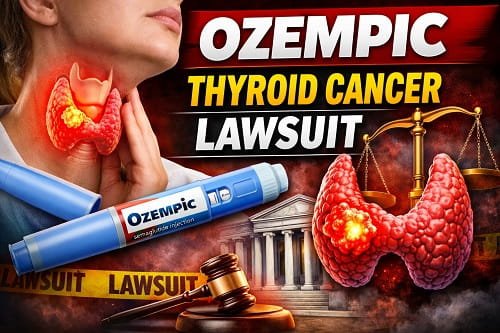
The legal battle around Ozempic has taken a new turn in recent months. While most lawsuits earlier focused on stomach paralysis and vision loss, a growing number of claims are now raising concerns about a possible link between Ozempic and thyroid cancer. The situation is still evolving, and the truth sits somewhere between legal allegations and scientific debate.
Here’s a clear, up-to-date look at what’s actually happening.
What Is the Ozempic Thyroid Cancer Lawsuit?
Ozempic, a popular diabetes and weight-loss drug made by Novo Nordisk, belongs to a class of medicines called GLP-1 receptor agonists. These drugs help control blood sugar and reduce appetite. But they also come with warnings that have now become the center of legal action.
Several lawsuits claim that patients developed thyroid cancer after using Ozempic. These cases argue that the manufacturer failed to properly warn users about the potential risks.
The key allegations include:
- Inadequate warning labels about cancer risks
- Failure to fully study long-term safety
- Patients developing thyroid tumors after prolonged use
These lawsuits are part of a broader wave of legal claims against GLP-1 drugs.
Why Thyroid Cancer Became a Concern
The concern didn’t come out of nowhere. Ozempic already carries an FDA boxed warning related to thyroid tumors. But here’s the catch—this warning is based on animal studies, not human evidence.
In rodent studies, the drug caused C-cell tumors in the thyroid. Because of that, regulators required a warning label, especially for a rare cancer called medullary thyroid carcinoma (MTC).
However, human data has been far less clear.
Recent studies suggest:
- No strong evidence linking Ozempic to thyroid cancer in humans
- The risk, if any, appears very low
- Some cases may be due to increased medical screening, not the drug itself
In fact, a 2026 update noted that GLP-1 drugs “do not appear to increase the risk of thyroid cancer in humans.”
This gap between warnings and real-world data is one reason lawsuits are gaining attention.
Current Legal Status in 2026
As of early 2026, Ozempic litigation is expanding quickly. Thousands of lawsuits have already been filed across the United States.
Key updates:
- Over 3,000+ lawsuits are active against Ozempic and similar drugs
- Cases are being combined into a multidistrict litigation (MDL) in Pennsylvania
- First major trials (called bellwether trials) are expected to begin in 2026
Although most lawsuits currently focus on gastrointestinal injuries, thyroid cancer claims are emerging as a separate category within the same legal wave.
What Plaintiffs Need to Prove
For a thyroid cancer lawsuit to succeed, claimants must show more than just a diagnosis.
Typically, they need:
- Confirmed thyroid cancer diagnosis
- Documented history of Ozempic use
- Medical evidence linking the drug to their condition
- Proof that warnings were inadequate
This is where things get difficult. Because scientific evidence is still uncertain, proving a direct cause is not easy.
Possible Compensation and Settlements
There is no final settlement yet for Ozempic cases. The litigation is still in early stages.
However, legal experts estimate potential payouts based on similar cases:
- Expected range: $50,000 to $700,000+ depending on severity
These are only projections. Actual payouts will depend on trial outcomes and medical proof.
The Big Debate: Science vs Lawsuits
This case is a classic example of law and science moving at different speeds.
On one side:
- Lawsuits argue there is a real cancer risk
- Some case reports suggest possible links
On the other side:
- Large human studies show no clear increase in thyroid cancer
- Experts say the warning is mostly precautionary
Even doctors remain cautious. Patients with a personal or family history of medullary thyroid cancer are still advised to avoid these drugs.
What This Means for Patients
If you are using Ozempic or thinking about it, here’s the practical takeaway:
- The drug is still widely prescribed and considered effective
- There is no confirmed strong link to thyroid cancer in humans
- But warnings exist, so caution is advised in high-risk individuals
Most importantly, don’t panic or stop medication suddenly. Decisions should be made with a doctor, not headlines.
Final Thoughts
The Ozempic thyroid cancer lawsuit is still in its early stages, and the outcome is far from certain. Right now, it reflects more of a legal concern than a proven medical reality.
Still, the situation matters. It raises important questions about drug safety, long-term risks, and how much companies should disclose upfront.
As 2026 unfolds, the first court trials will likely shape everything—from public perception to possible settlements. Until then, this remains a developing story where facts are still catching up with claims.